Published on May 18, 2026
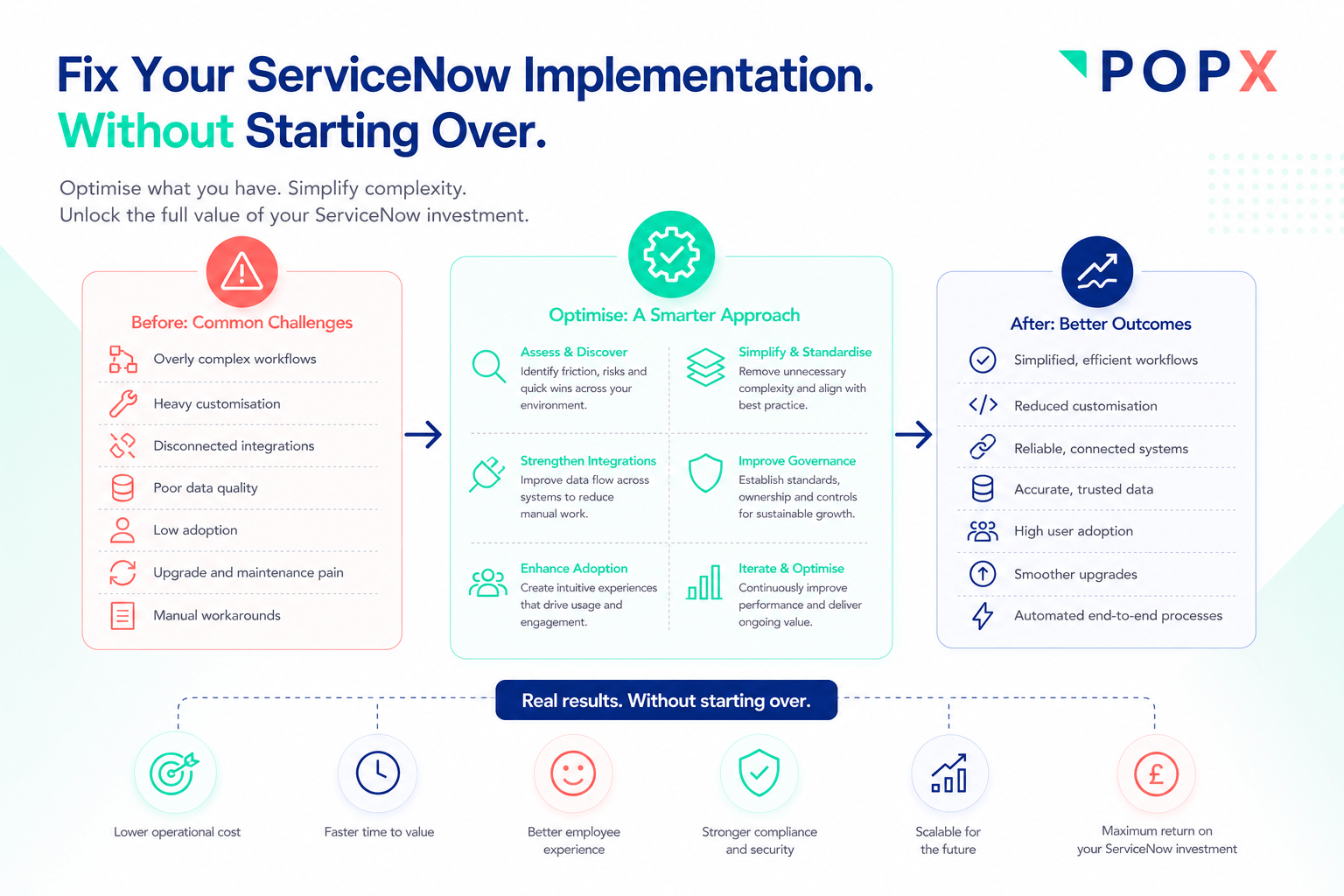
For many enterprise organisations, ServiceNow begins with a clear vision: streamlined operations, improved employee experiences, and better visibility across IT services.
But somewhere along the way, things become more complicated.
Workflows multiply. Customisations grow. Integrations become difficult to manage. Teams work around the platform rather than with it. Upgrades become stressful, adoption slows down, and the original goals of the implementation begin to drift further out of reach.
At this stage, many organisations start asking the same question: Do we need to start over?
In most cases, the answer is no.
A struggling ServiceNow environment rarely requires a complete rebuild. More often, it needs a structured optimisation strategy that simplifies operations, improves governance, and realigns the platform with the needs of the business.
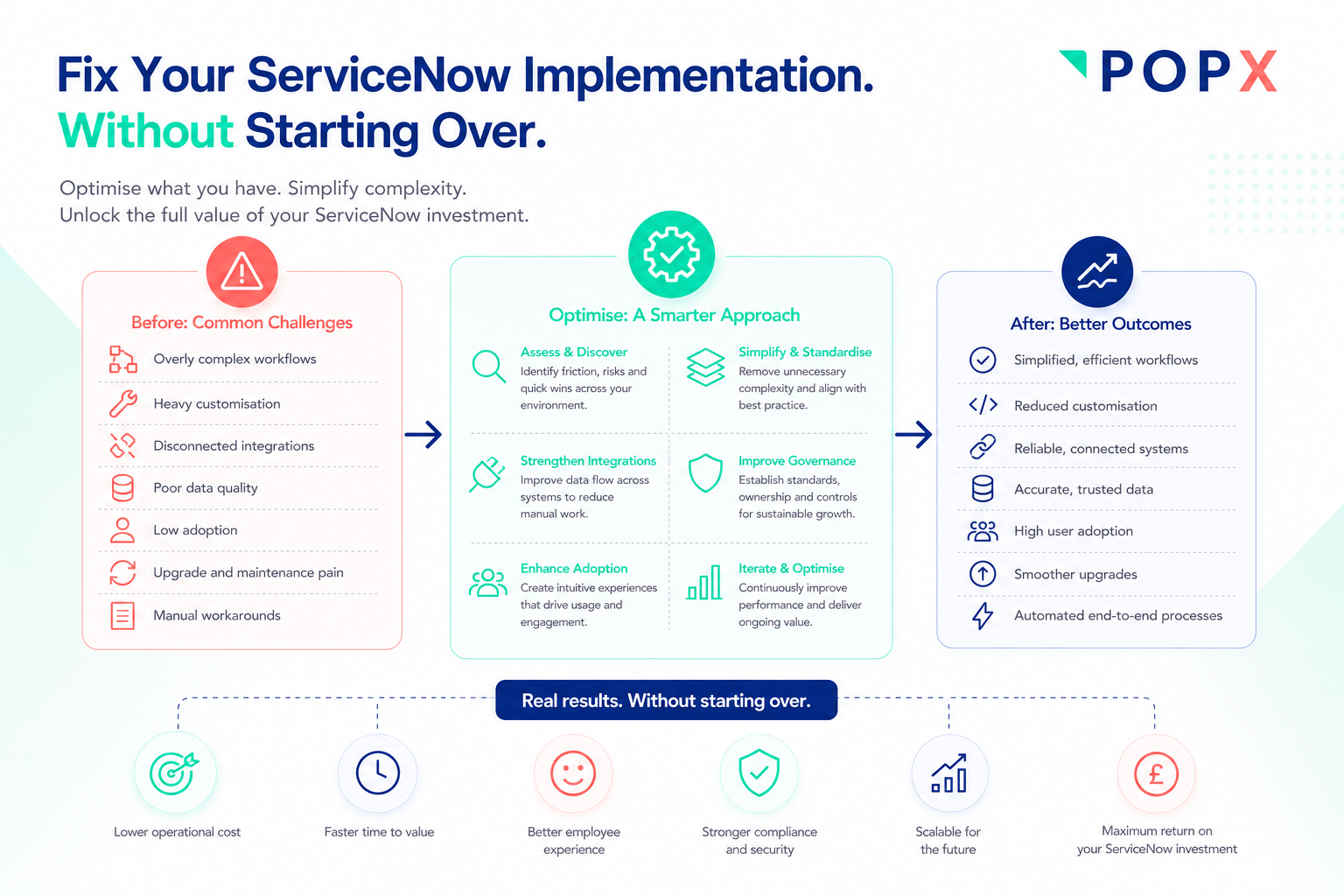
Why ServiceNow Implementations Lose Momentum
Most ServiceNow environments do not fail because of the platform itself. They become difficult to manage because enterprise requirements evolve faster than the operational model supporting them.
What starts as a focused ITSM implementation often expands rapidly across departments, regions, and business functions. New workflows are added under pressure, teams create their own custom processes, integrations are layered on over time, and short-term fixes gradually become long-term operational challenges.
As this complexity grows, organisations often begin to experience the same warning signs:
- Workflows that are difficult to maintain
- Over-customised processes
- Poor data quality across the CMDB
- Slow user adoption
- Manual workarounds outside the platform
- Upgrade challenges
- Limited visibility across operations
- Rising support overhead
The issue is rarely that ServiceNow cannot meet the organisation’s needs. More often, the environment has simply become fragmented over time.
The Problem With Starting Again
When organisations become frustrated with their platform, the temptation is often to consider a full reimplementation. However, rebuilding from scratch is rarely the most effective approach for enterprise IT teams.
Large-scale implementations involve significant operational disruption, high internal resource requirements, retraining efforts, and the risk of recreating many of the same problems if governance and architecture issues are not addressed first.
More importantly, most organisations already have valuable processes, integrations, and operational knowledge embedded within their existing environment. The smarter approach is usually to identify what is working, simplify what is not, and create a clearer roadmap for optimisation.
Start by Identifying Operational Friction
Before making major technical changes, enterprise organisations need a clear understanding of where the biggest operational bottlenecks exist. In many environments, the root causes are surprisingly consistent.
Workflows may contain unnecessary approvals or duplicated logic. Teams may have introduced customisations that bypass standard platform functionality. Integrations may no longer align cleanly with identity systems, endpoint management platforms, or HR processes. In some cases, departments may have built entirely separate operational models within the same instance.
Without addressing these underlying issues, adding more automation or additional modules often increases complexity rather than reducing it. A successful optimisation programme focuses first on simplifying the operational model.
Simplification Often Delivers the Biggest Gains
One of the most effective ways to improve a ServiceNow implementation is to reduce unnecessary complexity.
Over time, many organisations accumulate heavily customised workflows that become difficult to support and expensive to maintain. In some cases, processes have been automated exactly as they existed historically rather than redesigned for efficiency.
Simplification involves stepping back and asking practical operational questions:
- Which workflows genuinely deliver business value?
- Where are teams relying on manual workarounds?
- Which approvals are slowing delivery unnecessarily?
- Are multiple teams solving the same problem differently?
- Which customisations could be replaced with standard platform functionality?
In many cases, simplifying workflows improves user experience and operational efficiency far more effectively than introducing entirely new features.
Governance Is Usually the Missing Piece
A common reason ServiceNow environments become difficult to scale is the absence of long-term governance. As organisations grow, multiple teams often make changes independently. New workflows are added quickly to meet immediate needs, but without consistent standards, documentation, or ownership models. Over time, this creates fragmentation across the platform.
Strong governance helps organisations regain control of their environment by introducing:
- Clear workflow standards
- Defined ownership structures
- Consistent integration principles
- Upgrade and release management processes
- Documentation standards
- Performance monitoring and reporting
The goal is not to slow innovation. It is to ensure the platform can evolve sustainably as business requirements change.
Integration Maturity Matters More Than Most Organisations Realise
Many ServiceNow challenges are not actually caused by workflows themselves. They stem from disconnected systems and inconsistent data across the enterprise. When HR systems, identity platforms, endpoint management tools, security solutions, and operational databases are poorly integrated, manual intervention quickly fills the gaps. This creates delays, duplicate records, inconsistent user experiences, and increased operational overhead.
Optimising integrations often unlocks major improvements without requiring significant changes to the core ServiceNow platform itself. For example, improving synchronisation between HR, identity management, and provisioning systems can dramatically streamline on-boarding and off-boarding processes while improving compliance and reducing support tickets.
Integration maturity is frequently one of the highest-impact areas for enterprise optimisation.
Focus on Adoption, Not Just Configuration
Even technically strong ServiceNow implementations can struggle if employees and operational teams are not fully using the platform. Low adoption is often a sign that workflows are overly complex, processes are inconsistent, or the platform is not aligned with how teams actually operate day to day.
Improving adoption requires more than training. It requires creating simpler, faster, and more intuitive experiences for end users and operational teams alike. The most successful enterprise environments are typically the ones where ServiceNow becomes embedded naturally into operational workflows rather than feeling like an additional administrative layer.
Continuous Improvement Is More Effective Than Large-Scale Transformation
One of the biggest misconceptions about ServiceNow optimisation is that it requires a massive transformation programme. In reality, the most successful enterprise organisations often improve their environments incrementally.
Rather than attempting to redesign everything at once, they focus on high-impact operational areas first. This might include simplifying onboarding workflows, improving incident routing, optimising CMDB accuracy, reducing approval bottlenecks, or modernising integrations.
Over time, these improvements compound into a significantly more scalable and manageable platform. This approach reduces risk while allowing organisations to deliver measurable operational improvements much faster.
How POPX Helps Enterprise Organisations Optimise ServiceNow
At POPX, we help enterprise IT teams improve and optimise existing ServiceNow environments without unnecessary disruption. Our approach focuses on simplifying operations, strengthening governance, improving integration maturity, and helping organisations create scalable workflows that support long-term growth.
Rather than treating every challenge as a technical rebuild, we work with organisations to identify where operational friction exists and where meaningful improvements can deliver the greatest value. For many enterprises, the goal is not to replace what already exists. It is to make the platform work better for the organisation that exists today.
Final Thoughts
A difficult ServiceNow implementation does not automatically mean failure. In most cases, the platform itself is still capable of delivering significant operational value. The challenge is usually one of complexity, governance, integration, and alignment with evolving business needs.
Starting over is rarely the only option - and often not the best one. With the right optimisation strategy, enterprise organisations can simplify operations, improve adoption, reduce operational overhead, and unlock far greater value from the ServiceNow investment they have already made.